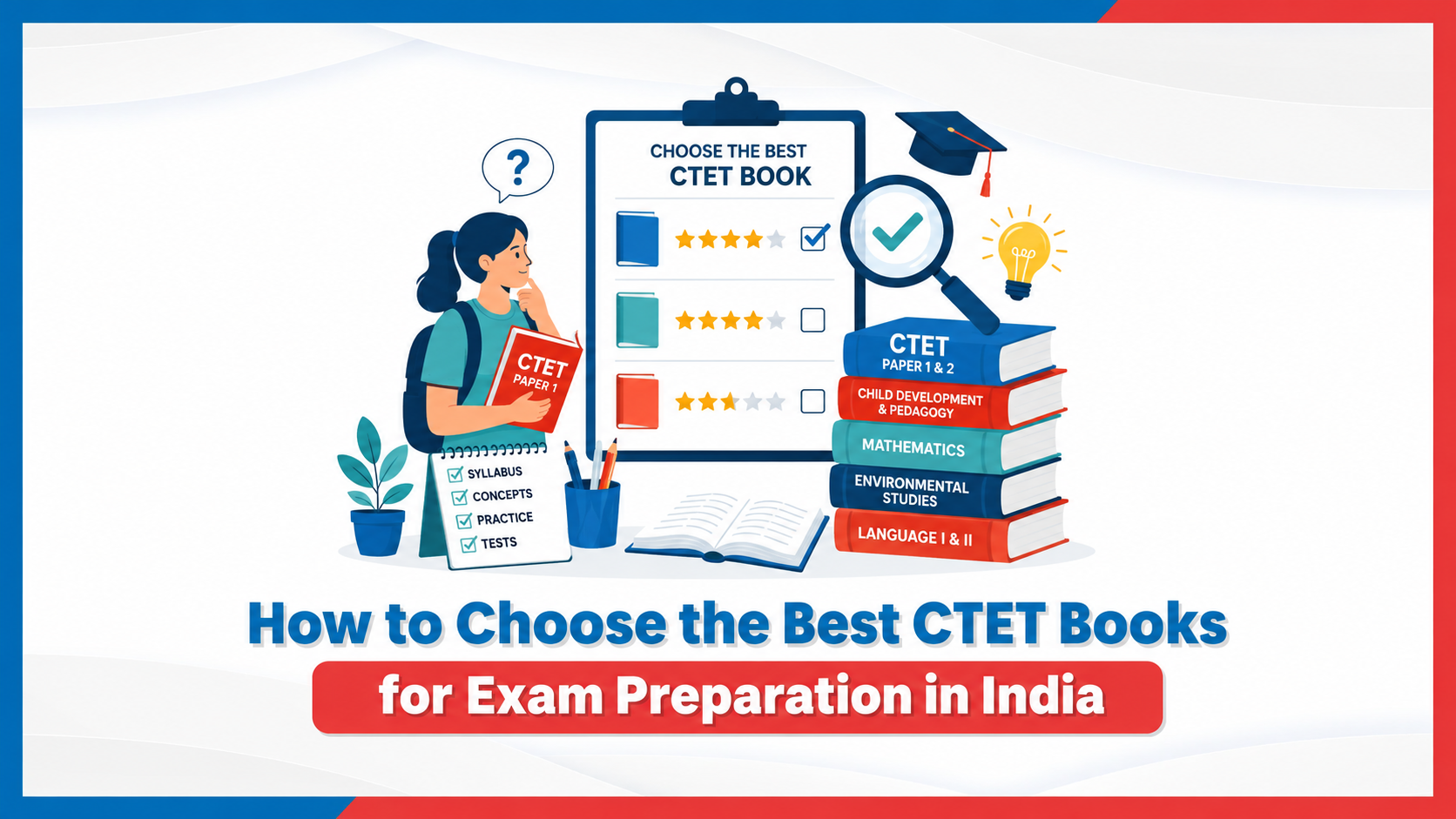
How to Choose the Best CTET Books for Exam Preparation in India

The Central Teacher Eligibility Test (CTET) is a challenging exam among government exams in India for teacher aspirants to get a job in central government schools. Organised by the Central Board of Secondary Education (CBSE), this examination is a prerequisite for applying for teaching jobs from Class I to Class VIII. With lakhs of candidates taking the exam every year, deciding on the right study material is what makes the difference between success and failure.
If you are preparing for this exam and feeling overwhelmed by the wide range of available study materials, you are not alone. This comprehensive guide will help you make an informed decision so your preparation journey is structured, effective, and efficient.
Understanding the CTET Exam Structure First
Prior to selecting any study material, you should know what you are studying for. The CTET exam comprises two papers:
- Paper I — For candidates proposing to teach Classes I to V (Primary Level)
- Paper II – For candidates desiring to teach Classes VI to VIII (Upper Primary Level)
Candidates who want to teach at both levels can attempt both papers.
Paper I covers:
- Child Development and Pedagogy
- Language I (compulsory)
- Language II (compulsory)
- Mathematics
- Environmental Studies
Paper II covers:
- Child Development and Pedagogy
- Language I (compulsory)
- Language II (compulsory)
- Mathematics and Science / Social Studies & Social Science (depending on the subject specialisation)
Each of the papers consists of 150 multiple-choice questions (MCQs), which are to be answered within 150 minutes and carry a total of 150 marks. Knowing this pattern is the first step in selecting the right CTET books, which are as per the CTET syllabus and exam pattern.
Why the Right Study Material Matters
Many aspirants make the mistake of collecting too many books or relying on irrelevant material. The right study material:
- Saves time by keeping your focus on the actual syllabus
- Provides conceptual clarity rather than surface-level information
- Includes practice questions and previous years’ papers
- Helps you understand pedagogy and child development, which are often the most tricky sections
The CTET is not only a content-based exam but also tests aspects of teaching, including teaching methodologies, child psychology, and classroom situations. Hence, the CTET preparation guide should not be only a mere knowledge of the subject but should also complete the pedagogical aspects.
Key Features to Look for in Good CTET Study Material
When buying any CTET exam preparation book, ensure the following:
- Coverage of the Entire Syllabus
The book should include 100% of the CBSE specified CTET syllabus without any omission. Before making the purchase, compare the contents of the table with the official CBSE notice.
- Updated Content
Patterns of questions of CTET are changing. Follow the latest pattern of questions. Ensure the book is the most recent edition and includes questions from past tests. Old-fashioned material can take your preparation in the wrong direction.
- Language Simple and Clear
As there are many aspirants from all other streams, the language of the book must be simple and easy to understand. Don’t make the content too academic or full of jargon, especially in the Child Development and Pedagogy areas.
4. Simple and Clear Language
Since many aspirants come from diverse educational backgrounds, the language of the book should be easy to understand. Avoid overly academic or jargon-heavy content, especially for the Child Development and Pedagogy sections.
5. Practice Questions and Mock Tests
A good book includes the following:
- Topic-wise practice questions
- Previous years’ solved question papers
- Full-length mock tests
- Detailed answer explanations
6. Pedagogical Focus
The Child Development and Pedagogy section is unique to CTET it is not just theory but application-based. Good books explain concepts with real classroom examples and case studies.
What to Look for in the Best Book for CTET Paper 1
For Paper I (Primary Level), your preparation focus areas should be:
- Child Development (6–11 years): Theories of learning, Piaget, Vygotsky, Kohlberg, inclusive education, assessment principles
- Environmental Studies (EVS): Integrated approach covering nature, family, food, shelter, water, travel, and things we make and do
- Mathematics: Numbers, operations, geometry, patterns, data handling are all taught with pedagogical understanding
- Language Pedagogy: Reading, writing, listening, and speaking with focus on how to teach, not just what to teach
A strong Paper I book should give equal importance to both content knowledge and how to teach that content at the primary level.
What to Look for in the Best Book for CTET Paper 2
Paper II (Upper Primary Level) demands subject specialisation. Here is what to focus on:
- Child Development and Pedagogy for 11–14 age group: Adolescent psychology, learning difficulties, motivation strategies
- Mathematics & Science (for Science teachers): Deeper content coverage from Classes VI–VIII NCERT, along with teaching approaches
- Social Studies/Social Science (for Humanities teachers): History, Geography, Political Science, Economics with pedagogical methods
- Language Pedagogy: More advanced reading comprehension and language learning theories
The best book for CTET paper 2 must address these subjects with the depth appropriate for upper primary-level teaching.
Preparing in Hindi? Here Is What You Need to Know
A large number of aspirants from Hindi-speaking states such as Uttar Pradesh, Bihar, Madhya Pradesh, Rajasthan, and Uttarakhand prefer to study in their mother tongue. For such candidates, the best book for CTET in Hindi is one that:
- Translates all concepts accurately without losing meaning
- Uses standard Hindi terminology for education and psychology concepts
- Includes Hindi medium mock tests and answer keys
- Is published by a credible educational publisher with expertise in teacher examination content
Studying in Hindi is equally valid and effective. The CTET exam is conducted bilingually, so Hindi-medium aspirants are at no disadvantage.
Role of NCERT Books in CTET Preparation
No CTET preparation is complete without NCERT textbooks. These are foundational for:
- Content knowledge in Mathematics, EVS, Science, and Social Studies
- Understanding the pedagogy used in Indian classrooms
- Grasping the language and framing of CTET questions
NCERT books from Classes I to VIII are a must-read for all aspirants, regardless of which paper they are preparing for. Use them alongside your primary preparation guide to strengthen your content base.
Common Mistakes to Avoid During Preparation
- Buying too many books: Focus on quality over quantity. Two to three well-chosen books are enough.
- Ignoring pedagogy: Many candidates focus only on subject content and neglect teaching methodology. This is a costly mistake.
- Skipping revision: Reading once is never enough. Revise each section at least twice.
- Not solving mock tests: Practice papers give you the exam rhythm and speed needed on the actual day.
- Relying only on notes: Notes are supplements, not substitutes for a comprehensive preparation book.
Selecting appropriate study material is the first and most vital investment you need to do while going through the CTET process. This examination aims to test both your theoretical and application skills related to the subject matter in the teaching environment. So whether you’re attempting paper I or II, choosing study material in English or Hindi – ensure that you select the best ones, which are aligned according to the ctet syllabus, pedagogy-rich, and practice-orientated.
You should remember thousands of teachers from all across India cleared this exam using suitable resources & keeping consistency on their path. So don’t lose hope; keep working towards your goals. You can also achieve success by sticking with the right plan!
FAQs
Q1. How many books are enough for CTET preparation? As far as the number of books is concerned, we recommend getting at least two-three books. One book must be the comprehensive guidebook according to your choice of paper. Also, get last year’s question papers along with NCERT textbooks (classes i-viii)
Q2. Is NCERT enough for CTET preparation? No, NCERT books will definitely help for the content portion but won’t be enough for the CTET Exam Preparation. Alongside NCERT books, you need a dedicated preparation guide which should cover all topics related to Child development & pedagogy and language pedagogy and also provide a lot of exam-pattern-based questions.
Q3. Can I prepare for both CTET Paper 1 and Paper 2 simultaneously? Yes, you can. Since the Child Development and Pedagogy and Language sections overlap between both papers, you can study them together and then focus separately on the subject-specific sections of each paper.
Q4. How important is the Child Development and Pedagogy section in CTET? It is extremely important. This section has 30 questions in both Paper I and Paper II, making it the single largest topic in the exam. It is also one where candidates often lose marks due to conceptual confusion. Strong preparation in this area can significantly boost your overall score.